Program Manager
Archaeology Law and Legislation
Melissa Belk: What is your job title and what locations do you work in?
Andrew Miller: I’m a program manager. I work remotely out of the ASM Carlsbad office. My job is to track the policy and political environment that the company works within so that I can advise our colleagues about the changing landscape of legislation, whether that’s at the federal level or at various state levels in the offices that we work in, and then I work with our colleagues there to come up with strategies for procurement and for doing technical work. And on top of that, I also manage a few projects for BLM and EPA.
MB: What does a typical day-to-day involve (working in the field, an office, or remotely)?
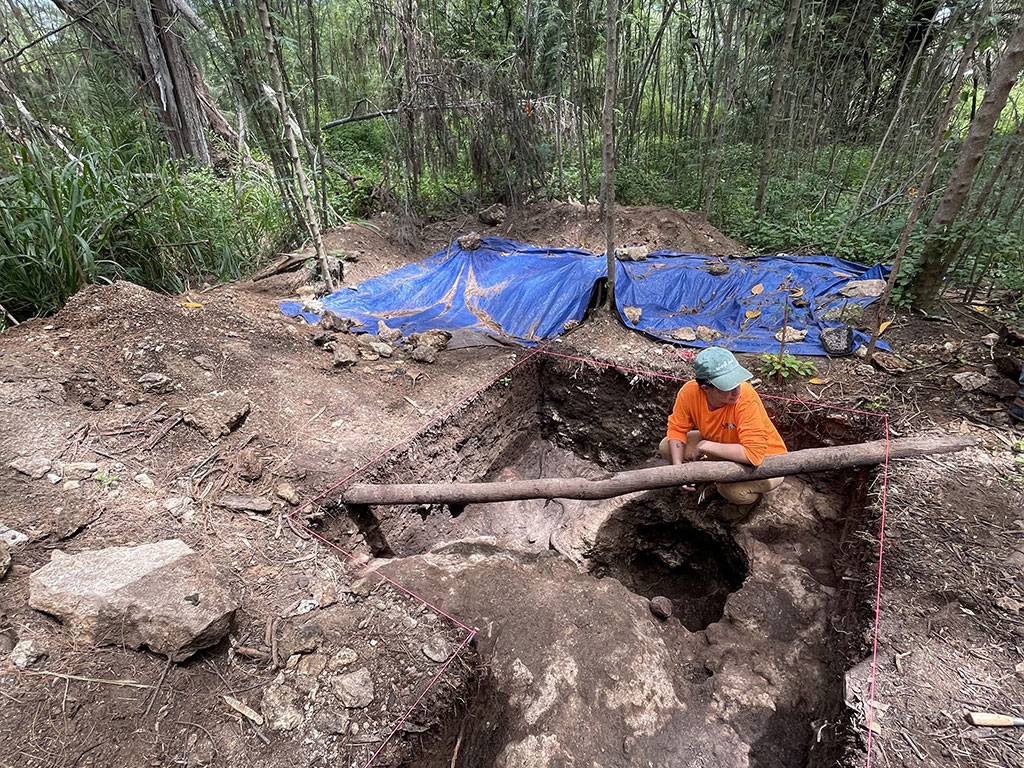
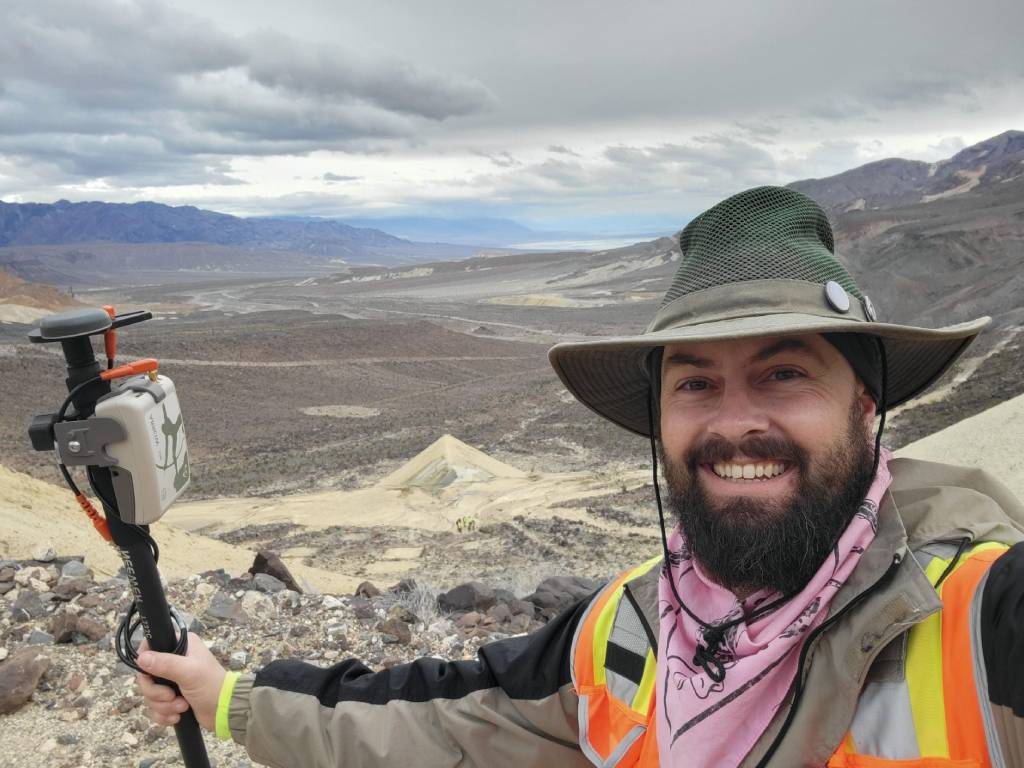
Andrew: It’s been a long time since I’ve had to go out in the field on a day-to-day basis, but when I started this career 15 some years ago, that’s how I lived. I was in the hotel, in my truck, at a campground, 9 to 5, either surveying or excavating, leading those crews, writing reports from the bed of the truck, sending emails and phone calls after hours from the hotel room. These days having an office at home is something I’m very grateful for.
MB: Is there a moment in your life that made you decide to be an archaeologist or was it something that inspired you when you were younger?
Andrew: I’ve always loved history and my parents raised me to have a kind of “leave nothing but footprints” attitude towards the natural world, for landscapes, for wildlife. And so, I think that attitude just kind of permeated into my education. And as I went through college, I had internships with preservation organizations. Then when I went to graduate school, I realized that the only people graduating on time with jobs in the wings were the archaeologists. So, I thought it would be just a wiser decision to switch over from general anthropology to specifically archaeology. And it was probably one of the better career moves I’ve ever made.
MB: When you left school, did you go right into a job?
Andrew: I did, yeah. My first gig out of grad school was with Gray and Pape (CRM Firm) in Cincinnati, and it was a Indiana Department of Transportation project. And no sooner was I done with coursework than I was given a bunch of cash per diem, a bunch of expensive equipment and a big truck and told to drive out into the sticks in Indiana and go survey. And it’s literally just been one project after another since then. It started in the field doing tech work, then leading crews myself, taking on field director positions, and then working my way into an office and writing reports.
MB: That’s quite a journey. How long have you been an archaeologist?
Andrew: Yeah. Yes, it is. 17 years.
MB: Do you have a favorite snapshot or moment of your career (aside from now, of course)?
Andrew: Yeah, I loved working for the BLM when I was a federal archaeologist, working with an interdisciplinary team of paleontologists and biologists, geologists, various kinds of engineers on big infrastructure projects, renewable energy projects. These were, they were complicated and multifaceted, but ultimately the type of feel-good infrastructure that everybody wants. Everybody wants lower electrical rates. Everybody wants to use less petrochemicals. Everybody’s down with renewable energy. And so when you get that kind of agreeability in a room together, even if there are preferences for a particular field. Maybe the biologists have a preference, maybe the tribal representatives have a preference, but working within that milieu to get to an actionable plan is very satisfying. Collaboration is good stuff.
MB: That’s amazing, having a team of people with all these different skills coming together.
Andrew: Yeah, we had a mission. That was the thing. I think that was, that’s probably what made that unique. You always want to be ethical in every project you work on, but we don’t necessarily get to work on what the final product is going to be. We’re just doing cultural resources for the sake of consulting and informing. But on an interdisciplinary team, were kind of driving the ethics of the project. That was different.
MB: What do you think archaeology gives to society? What do you think is its most important function?
Andrew: If you forget the past, you’re doomed to repeat it. It’s cliche. It’s true. I think that humans have very similar needs across cultures and one of those needs is a story….where people came from, why are we here, where are we going? And in the absence of material culture, people with bad intentions can come along later and make things up. It’s important to have material culture conserved and preserved, not just for the people who are around now, but for the innumerable generations to come. They have a right to know where they came from.
There’s no point in setting up future generations for failure and ignorance. We should set them up with a clear understanding of how the human species got to the point it is now. Why not leave the next group of human beings with as many points of data and tools as possible to make good decisions for their subsequent generations. So, it’s a deep-time project.
MB: What artifact that either you personally found or that you’ve ever read about, do you feel like you wish everyone could see or know about?
Andrew: My favorite, my favorite thing that I’ve ever seen in a museum was the Venus of Willendorf in the Kunsthistorisches Museum in Vienna, Austria. It’s a Paleolithic feminine figurine. It’s really, really well known. It’s a really iconic artifact but what struck me when I saw it is that it’s about the the height of my thumb. I didn’t realize that such a famous item could actually be physically so small.
And my favorite cultural material that I found personally was when I lived out east. I worked on a team that excavated A Scots-Irish homestead way back in the sticks in West Virginia. We thought it was going to be a straightforward first- or second-generation European immigrant homestead with those typical kinds of assemblages…you know, ceramic and kaolin, and iron, not a lot of steel, all the homemade iron work stuff. But then directly beneath that layer, we started finding Portuguese coins and some of the earliest English colonial coinage. And then beneath that, we found a West African grigri (talisman or amulet), which is a sacred bundle that’ll have various powerful items in there to consecrate an area. And where we found this grigri, it was filled with coins, rock crystals, and marbles. And it was underneath the lintel stone of the house of the homestead. So at first we thought this is too early for enslaved people to be in this part of West Virginia, but we were under the impression that it was a European immigrant family. But they’re using West African sacred items. What is going on here? That changed the entire hypothesis around the excavation. And then of course, in the subsequent layer, it’s all old stone tools. So we’re looking at a habitation spanning, you know, at least 1,000 years and containing so many old-world ethnic practices confined in a really discrete space. Really fascinating and I haven’t really seen anything like that since.
MB: I’ve never even heard of anything like that. That’s fascinating.
Andrew: Yeah, it was really cool. But that was like a while ago. That was around 15 years ago.
MB: What do you enjoy most about your work?
Andrew: Working with people. I like people. I wouldn’t have gotten an Anthropology degree if I didn’t like people. And so, I enjoy working with scientists and I like working with the tribal representatives. I like working with the engineers, and the designers, and the lobbyists, and our professional advocates. What’s so great about anthropology is it’s holistic. You don’t have to just stick to a single type of study, you don’t have to stick to a single kind of hypothesis testing or technological specification. You can be broad.
MB: Do you have any special interests or hobbies that might have helped you in archaeology?
Andrew: I mean, I could make a stretch. I ski. And the ski areas that I go to, are public lands. And so, Big Bear, Mammoth, all the ski areas around Tahoe, the vast majority of those are leased from the Forest Service. And the same attitude that I have towards archaeology in which it is a public good and it should stay on public lands and in public control. That attitude is informed by the same position I have about ski areas and rock climbing and stuff like that is, you know…this land is going to be occupied by somebody else. It’s not yours. Treat it with respect, but enjoy yourself.
MB: I like that ethos. What advice would you give to an aspiring archaeologist or a student who maybe has an interest in archaeology?
Andrew: Take a field school, volunteer for an excavation or a survey, etc.. If you are in college and you take a field school, the next chance you get to either volunteer or make some money doing archaeology in the field, go out on survey, go out on excavation, do more than a couple…Get an idea for how the academics actually play out on the ground. Seeing is believing. Go out and do it.
Interviewed by Melissa Belk on July 13, 2026